Post-Hurricane Delayed Mold Remediation Port Charlotte
Post-hurricane delayed mold remediation addresses hidden moisture and suspected mold discovered weeks or months after storm damage in Port Charlotte, FL. Explore delayed mold growth, concealed moisture, professional assessment, remediation scope, and material restoration throughout Charlotte County and Southwest Florida.
Request Restoration Help
Tell us about the property damage and the location. Submit your inquiry so the appropriate next steps can be discussed.
Delayed Mold Problems After Hurricanes in Port Charlotte
Moisture from a hurricane or major storm can remain in hidden building assemblies long after the visible water has receded, and that residual moisture can contribute to mold growth that is discovered weeks or even months later. A roof leak that let wind-driven rain into an attic, storm surge that saturated the lower wall cavities, floodwater that was not fully dried before the wall was closed, or insulation that held moisture behind a drywall surface can all create the conditions for delayed mold. In Port Charlotte and Charlotte County, where hurricane exposure is a recurring reality, the discovery of suspected mold after a storm is a common and understandable concern.
What makes delayed mold different is the gap between the storm and the discovery. The moisture entered during the storm, but the mold may not become visible — or noticeable by odor — until weeks or months later, when a musty smell, a wall discoloration, or a softened ceiling prompts investigation. By that point, the moisture may have affected drywall, insulation, framing, cabinetry, or subflooring that was not fully addressed during the initial storm response. The timeline and the cause must be assessed rather than assumed, because not every post-storm odor or stain indicates mold, and not every mold condition traces to a single storm.
This page is distinct from the broader Mold Remediation and Hurricane Damage Restoration pages. It focuses on the specific relationship between storm-related moisture and later mold concerns — the hidden moisture, the delayed discovery, the assessment of what the storm left behind, and the remediation that addresses it. Mold growth requires moisture and suitable conditions, and the remediation must address both the visible contamination and the unresolved moisture source to be effective. Florida licensing and professional-role requirements apply to mold assessment and remediation, and the page does not imply that a single unverified company can provide all assessment, testing, remediation, and reconstruction services.
Signs of Hidden Mold Following Hurricane Damage
The signs of delayed mold after a storm are often subtle at first — appearances and smells do not identify mold species or establish health effects, but they warrant evaluation:
Post-Hurricane Mold Assessment & Remediation
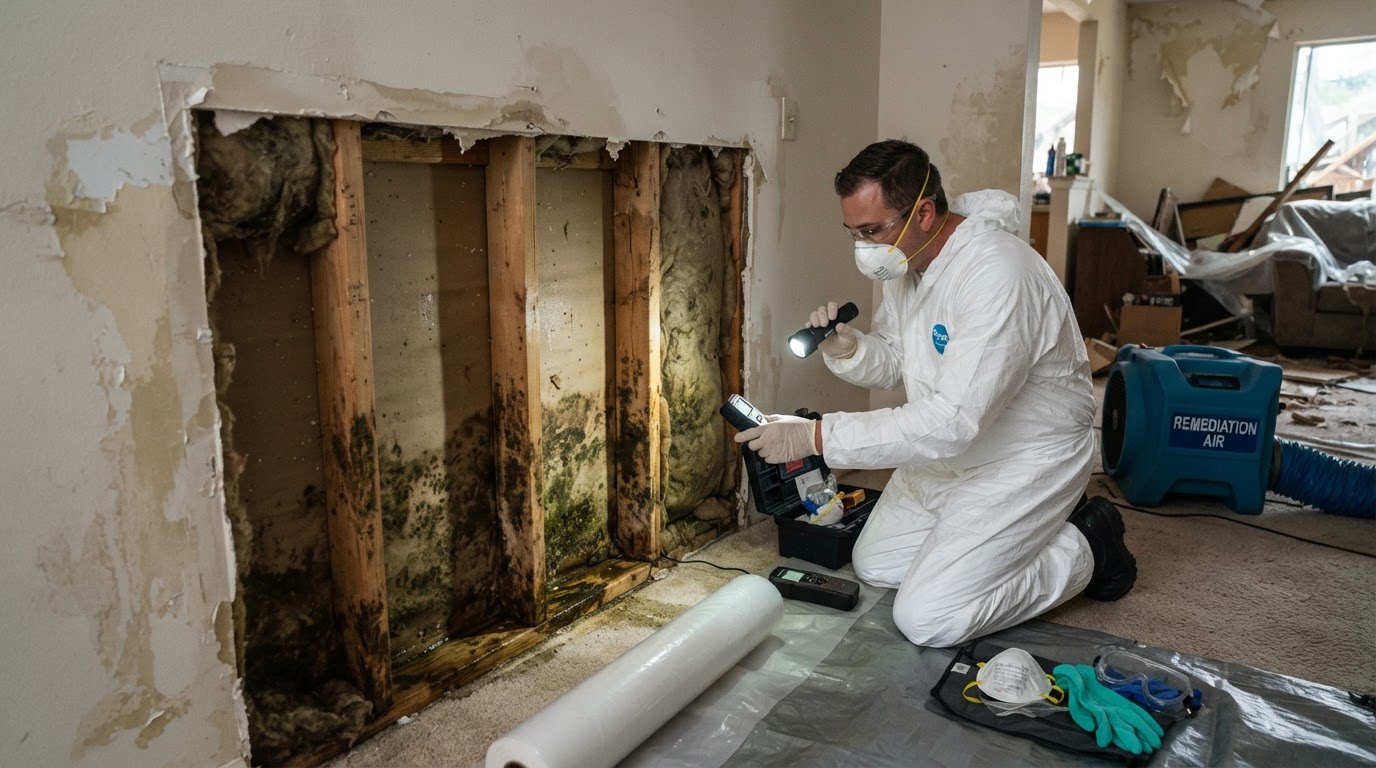
The assessment begins with a review of the water damage history — what happened during the storm, what was wet, what was dried, and what may not have been fully addressed. Current moisture conditions are assessed to identify whether water remains in hidden assemblies, and unresolved water sources — a roof leak that was not repaired, a plumbing failure that was not corrected, a wall cavity that was closed before it was dry — are identified, because remediation cannot succeed while moisture continues to enter. The suspected contamination is evaluated to determine whether qualified mold assessment is appropriate and to establish the remediation scope.
Where remediation is indicated, suitable containment is established where required to prevent the spread of contamination during the work, and affected porous materials are evaluated for cleaning versus removal. Controlled remediation is performed within the qualified scope, addressing the contaminated materials and the surrounding areas. The moisture sources and the drying are addressed — the unresolved leak is corrected, the wet assembly is dried — because remediation without moisture correction invites the problem to return. Post-remediation verification may be considered where appropriate to confirm the remediation goals were met.
Restoration of the damaged materials follows the remediation — the drywall, insulation, flooring, or finishes that were removed are replaced, and the affected areas are restored. The documentation records the water damage history, the moisture conditions, the remediation scope, and the restoration, which supports both the recovery and any insurance discussion. Florida licensing and professional-role requirements apply: mold assessment and remediation may involve distinct professional roles, and the page does not imply that a single unverified company can provide all assessment, testing, remediation, and reconstruction services. The appropriate professionals are coordinated according to the actual conditions and the applicable requirements.
1. Review Water Damage History
Review what happened during the storm, what was wet, and what may not have been fully addressed.
2. Assess Current Moisture
Assess current moisture conditions to identify whether water remains in hidden assemblies.
3. Identify Unresolved Sources
Identify unresolved water sources — roof leaks, plumbing failures, or wet assemblies closed too early.
4. Evaluate Suspected Contamination
Evaluate suspected contamination to determine whether qualified mold assessment is appropriate.
5. Determine Remediation Scope
Determine the remediation scope based on the assessment and applicable requirements.
6. Establish Containment
Establish suitable containment where required to prevent the spread of contamination.
7. Evaluate Affected Materials
Evaluate affected porous materials for cleaning versus removal.
8. Controlled Remediation
Perform controlled remediation within the qualified scope.
9. Address Moisture & Drying
Correct moisture sources and dry the affected assembly so remediation can last.
10. Post-Remediation Verification
Consider post-remediation verification where appropriate to confirm remediation goals were met.
11. Plan Material Restoration
Plan the restoration of drywall, insulation, flooring, or finishes that were removed.
12. Document the Process
Document the water history, moisture conditions, remediation scope, and restoration.
Delayed Storm Damage Mold Near Port Charlotte Homes
In Port Charlotte and Charlotte County, Gulf Coast hurricane conditions can drive water into homes through multiple paths — roof intrusion from wind-driven rain, storm surge through ground-level openings, canal-front flooding, and storm-related plumbing or HVAC failures. When that water is not fully removed and the affected assemblies not fully dried before they are closed, the residual moisture can support mold growth that appears later. Seasonal property occupancy adds the dimension of delayed discovery: a home that flooded during a storm and sat unoccupied may not reveal the mold until the owner returns weeks or months later.
Wet drywall and insulation that were not addressed during the initial storm response, unnoticed moisture inside wall cavities, and mold-like growth that appears after reconstruction are all common delayed-discovery scenarios. The delayed discovery does not automatically establish when the damage began or whether a particular storm caused it — the timeline and the cause are assessed from the conditions and the history, not assumed. Where the moisture traces to an unresolved roof leak or plumbing failure, that source must be corrected as part of the remediation, because remediation without moisture correction invites recurrence.
The Mold Inspection & Testing page addresses the assessment role, and the Mold Remediation and Mold Removal pages address the remediation work, while this page focuses on the specific delayed-discovery scenario after storm damage. The Seasonal Home Leak Damage & Mold page addresses the related concern of damage discovered after an extended absence. The documentation reflects the water damage history, the moisture conditions, the remediation scope, and the restoration, which supports both the recovery and any insurance discussion. Florida licensing and professional-role requirements apply throughout, and the appropriate professionals are coordinated according to the actual conditions.
Related Water Restoration Services
These related services often appear alongside post-hurricane delayed mold remediation in Port Charlotte properties.
Post-Hurricane Delayed Mold Remediation FAQs
Clear answers to the questions property owners most often ask about post-hurricane delayed mold remediation in Port Charlotte. Review them, then share your property details so the appropriate next steps can be discussed.
Request Post-Hurricane Mold Remediation Help
Tell us about the property damage and the location. Submit your inquiry so the appropriate next steps can be discussed.