Storm Surge & Hurricane Flood Cleanup Port Charlotte
Storm surge and hurricane flood cleanup addresses the saltwater and wind-driven rain that Gulf tropical systems push into Port Charlotte coastal and canal-front properties. Explore how saltwater contamination, corrosion risk, electrical safety evaluation, and monitored structural drying shape a coastal storm recovery — and why surge cleanup is distinct from both a clean plumbing loss and general freshwater flooding.
Request Restoration Help
Tell us about the property damage and the location. Submit your inquiry so the appropriate next steps can be discussed.
Hurricane Flooding & Storm Surge Damage Near Port Charlotte
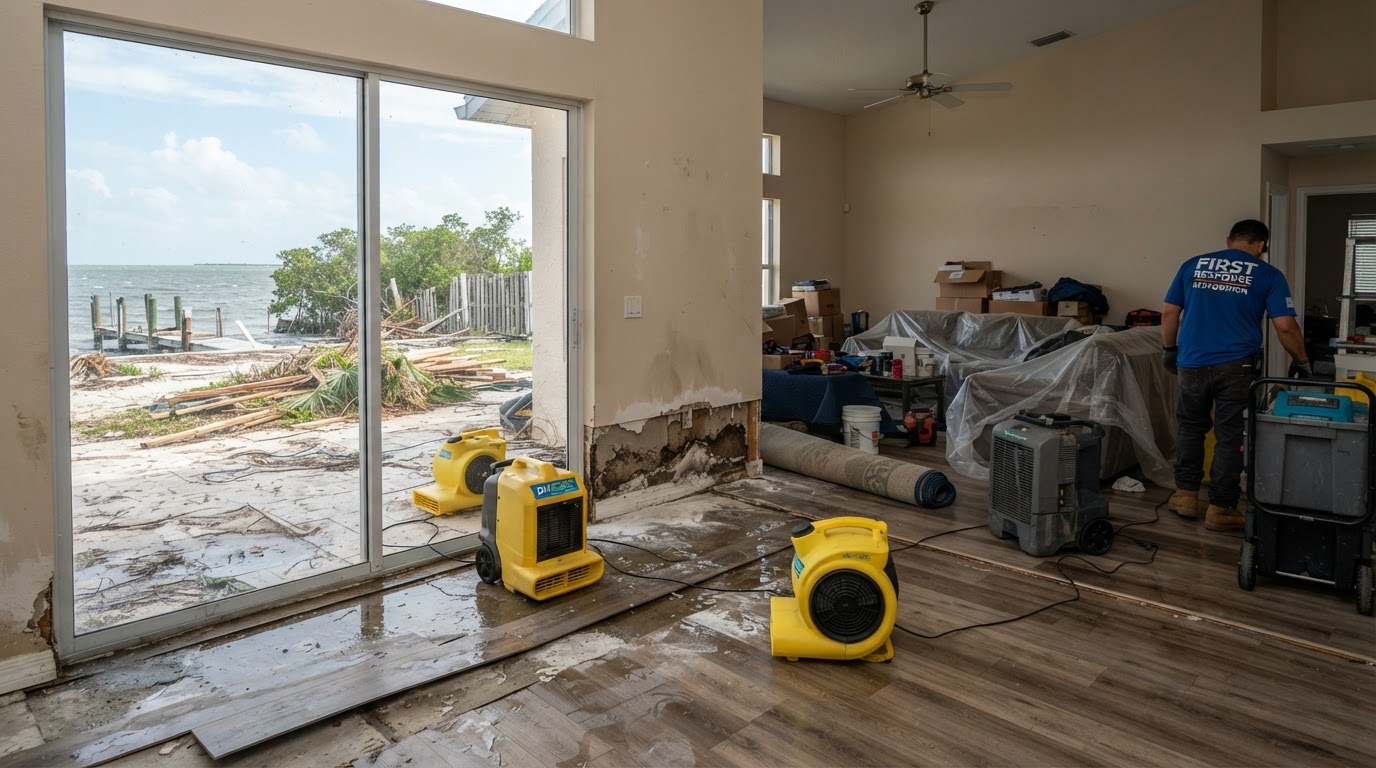
Storm surge is the rise of Gulf water driven ashore by a tropical storm or hurricane, and along the Charlotte County coast it pushes saltwater — and everything it carries — into ground-level interiors, canals, and low-lying property. Unlike rainfall flooding or a freshwater plumbing loss, storm surge introduces saltwater, which has its own destructive behavior: it deposits salt residue, accelerates corrosion of metal components and electrical wiring, and leaves a contamination profile that freshwater does not.
Wind-driven rain is the other major hurricane water-loss path. Hurricane-force wind forces rain horizontally beneath soffits, around roof vents, and through even small failures in the roof and window envelope, delivering water into wall cavities and ceiling assemblies that never touched the ground. Canal-front and harbor-adjacent properties face the combined exposure of surge and wind, and seasonal residences that sit empty through storm season can accumulate days or weeks of hidden water intrusion before the owner returns.
It is important not to treat every Charlotte County address as having identical storm exposure. Surge risk varies sharply with elevation, proximity to the harbor and canals, and the specific structure. What is consistent is that any saltwater- or surge-affected property needs a cleanup approach that accounts for corrosion, contamination, and the longer drying timeline that humid Gulf air imposes.
Saltwater Flood Damage & Hidden Property Concerns
Saltwater and storm-surge exposure create damage conditions beyond a standard flood. These are the concerns a storm-surge cleanup must address:
How Storm Surge & Hurricane Flood Cleanup Works
Cleanup after a surge event follows a safety-first, contamination-aware sequence. The site is assessed for electrical, structural, and biological hazards before entry, and energized electrical systems that contacted saltwater must be evaluated and cleared by a qualified electrical professional before power is restored — never re-energize flood-affected electrical equipment on assumption. Water is removed and classified, and saltwater exposure is documented because it drives both the salvage decisions and the downstream corrosion monitoring.
Debris is managed and disposed of appropriately. Porous materials that absorbed contaminated saltwater are evaluated for removal, and affected assemblies are cleaned and sanitized where appropriate. The structure is then moved into monitored structural drying, with particular attention to moisture retained inside concrete block and slab assemblies that release it slowly. Finally, the reconstruction scope is planned and completed. This is not a process to rush: saltwater damage can continue to surface as corrosion weeks after the visible water is gone.
Site Safety Assessment
Confirm electrical, structural, and biological safety; saltwater-affected electrical systems require qualified evaluation before re-energizing.
Water & Contamination Removal
Extract stormwater and document saltwater exposure and contamination category.
Debris Management
Remove and appropriately dispose of sediment, debris, and contaminated materials.
Porous Material Evaluation
Assess drywall, insulation, flooring, and cabinetry for removal versus salvage.
Monitored Drying
Dry the assembly with attention to moisture held in concrete block and slab, and monitor for corrosion-related issues.
Restoration Planning
Scope and complete the reconstruction needed to return the property to a safe, dry condition.
Storm Flood Restoration for Charlotte County Coastal Properties
Charlotte Harbor and the canal-front communities of Port Charlotte and Punta Gorda sit squarely in the Gulf Coast storm exposure zone. Canal-front homes face surge traveling inward through the canal system, while ground-level interiors near the harbor can see direct surge entry. Seasonal residences add the delayed-discovery pattern — an owner who returns in October to find water intrusion from a storm weeks earlier, with microbial growth already established in the wall cavities.
Returning to a storm-damaged property safely means verifying electrical and structural conditions before entry, documenting the loss, and beginning drying as soon as conditions allow. The specific risks at any address depend on its elevation, construction, and proximity to water — not on a generic assumption about the whole region.
Related Water Restoration Services
These related services often appear alongside storm surge & hurricane flood cleanup in Port Charlotte properties.
Storm Surge & Hurricane Flood Cleanup FAQs
Clear answers to the questions property owners most often ask about storm surge & hurricane flood cleanup in Port Charlotte. Review them, then share your property details so the appropriate next steps can be discussed.
Request Storm Flood Cleanup Help
Tell us about the property damage and the location. Submit your inquiry so the appropriate next steps can be discussed.