
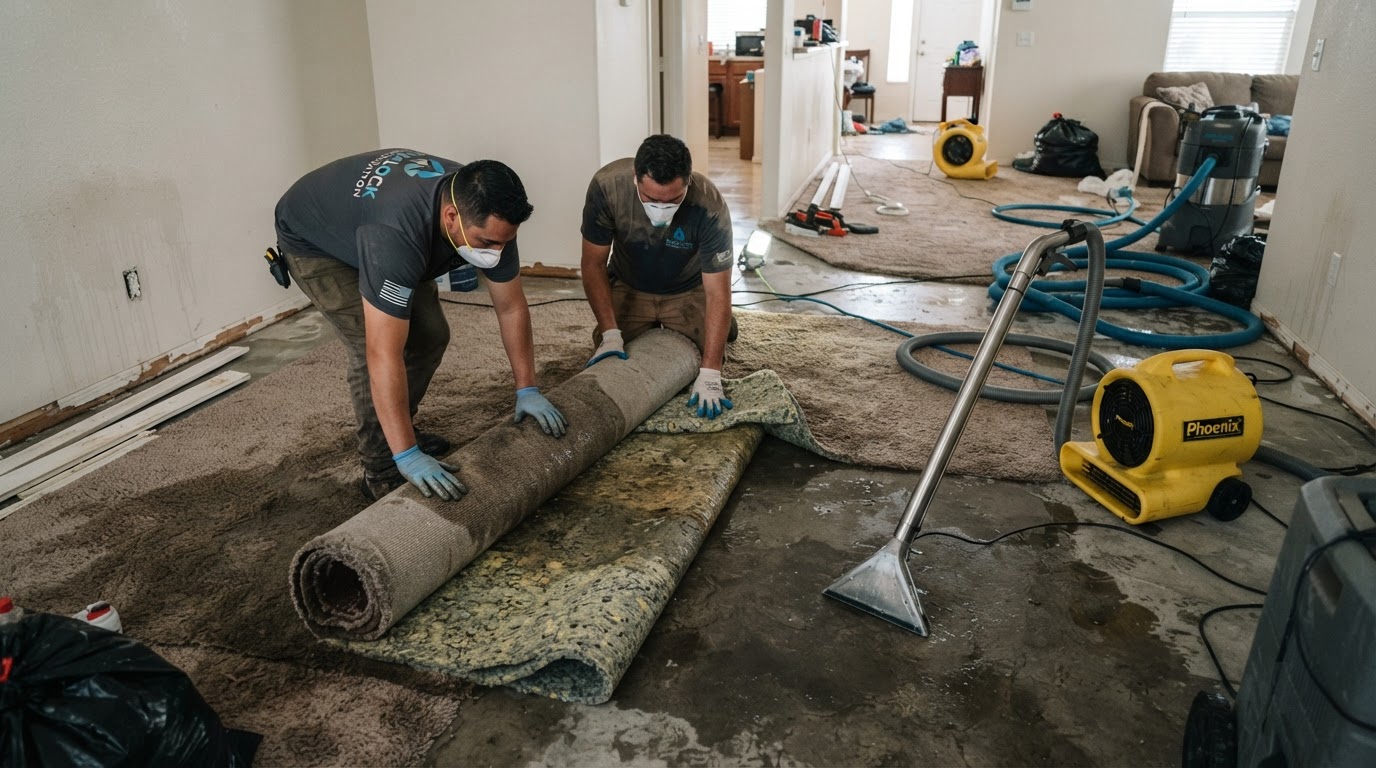
Wet Carpet & Padding Removal in Port Charlotte, FL
Carpet is one of the most absorbent materials in a home, and when it gets wet the moisture travels through the fibers, the backing, the padding, and into the subfloor below. In Port Charlotte, FL, explore how wet carpet and padding are assessed, when they can be salvaged versus removed, and how the subfloor is dried after a water loss.
Request Restoration Help
Tell us about the property damage and the location. Submit your inquiry so the appropriate next steps can be discussed.
What Happens When Carpet Gets Wet?
Carpet is one of the most absorbent materials in a home, and when it gets wet the moisture does not stay on the surface. Water travels through the carpet fibers, into the backing, through the padding beneath, and into the subfloor below — and the visible surface rarely reveals the full extent of the saturation. A carpet that looks only damp on top can be holding gallons of water in the padding and subfloor, which is why the restoration decision depends on what is beneath the surface, not what is visible.
Whether the carpet can be saved depends on several factors: the source of the water, how long the carpet has been wet, the construction of the carpet and padding, the extent of the saturation, and the condition of the subfloor beneath. Clean water from a burst supply line caught within hours is a different situation than storm floodwater that has sat for days, and the salvage decision follows the contamination category of the water. Padding, which is highly absorbent and slow to dry, is frequently replaced even when the carpet above it can be salvaged.
When the water source is contaminated — sewage, floodwater, or a Category 3 backup — the carpet and padding are generally removed and replaced rather than salvaged, because porous materials that have absorbed contaminated water cannot be reliably cleaned. The restoration is not represented as able to save every carpet; the decision is made case by case during the assessment, based on the water category, the material condition, and the applicable restoration standards.
Signs of Water Damage Beneath Wet Carpet
The visible surface of the carpet is only part of the picture. These are the signs that warrant a subfloor and padding moisture assessment:
Wet Carpet Removal & Subfloor Drying
Restoration begins with identifying the water source and stopping it, then classifying the water by its contamination category — clean supply water, grey water, or black water — because the category determines whether the carpet and padding can be salvaged or must be removed. Standing water is extracted with professional extraction equipment that pulls water from the carpet and padding, and a moisture inspection maps how far the water has traveled into the subfloor and the surrounding building materials.
The carpet and padding are then evaluated. Padding that has absorbed water is frequently removed and replaced, because it compresses when wet and does not dry effectively in place. Carpet exposed to clean water for a short period that retains its integrity can sometimes be dried in place with air movers and dehumidification, then reinstalled over new padding; carpet exposed to contaminated water is removed and replaced. The subfloor is assessed for moisture and dried with monitored airflow and dehumidification to verified targets, because the subfloor holds water longer than the carpet above it.
The surrounding materials — baseboards, tack strips, drywall at the floor line — are also assessed, because water that reached the carpet often wicked into the wall cavity as well. The scope is documented to support the carpet, padding, subfloor, and finish repair that follows, and the documentation reflects the water category, the materials removed, and the drying verified.
1. Damage Assessment
Identify the water source, stop it, and classify the water by contamination category.
2. Water Extraction
Extract standing water from the carpet and padding with professional extraction equipment.
3. Contamination Evaluation
Evaluate the water category to determine whether carpet and padding can be salvaged or must be removed.
4. Carpet & Padding Evaluation
Assess carpet and padding for salvageability versus removal based on water category and material condition.
5. Removal Where Necessary
Remove carpet and padding that cannot be salvaged, including contaminated materials.
6. Subfloor Drying
Dry the subfloor with monitored airflow and dehumidification to verified moisture targets.
7. Moisture Monitoring
Monitor moisture conditions until the subfloor reaches an appropriate dry standard.
8. Repair or Replacement Planning
Document the scope and plan carpet, padding, subfloor, and finish repair to return the area to pre-loss condition.
Wet Carpet Restoration Near Port Charlotte
In Port Charlotte and Charlotte County, the combination of slab construction, high humidity, and seasonal occupancy shapes how wet carpet is handled. Carpet over a concrete slab can trap moisture against the subfloor, and in humid conditions the padding and subfloor dry slowly — which raises the risk of microbial growth in the materials beneath the carpet if drying is delayed. A carpet that would dry in a day or two in an arid climate can hold moisture for a week or more here, which is why monitored drying matters.
Seasonal homes add a layer of complexity. A water loss in an unoccupied property can saturate the carpet, padding, and subfloor for an extended period before discovery, by which point the padding has often broken down and the subfloor has absorbed substantial moisture. In those cases, the assessment accounts for the extended exposure and the possibility of suspected mold conditions, evaluated under the applicable assessment and remediation considerations. The source is corrected and the assembly is dried before any replacement carpet is installed.
Related Water Restoration Services
These related services often appear alongside wet carpet & padding removal in Port Charlotte properties.
Wet Carpet & Padding Removal FAQs
Clear answers to the questions property owners most often ask about wet carpet & padding removal in Port Charlotte. Review them, then share your property details so the appropriate next steps can be discussed.
Request Wet Carpet Cleanup Help
Tell us about the property damage and the location. Submit your inquiry so the appropriate next steps can be discussed.