Filing Water Damage Claims After AOB Changes Port Charlotte
Florida water damage claims after Assignment of Benefits changes affect how Port Charlotte homeowners document restoration work and communicate with insurers. Learn about policyholder responsibilities, mitigation records, and factual damage documentation — an educational resource, not claims adjusting or legal advice.
Request Restoration Help
Tell us about the property damage and the location. Submit your inquiry so the appropriate next steps can be discussed.
Florida Water Damage Claims After Assignment of Benefits Changes
Florida property insurance has changed in ways that affect how water damage restoration work is documented and how a homeowner communicates with an insurer after a loss. Assignment of Benefits, commonly abbreviated AOB, historically allowed certain policyholders to transfer post-loss insurance benefits to a third party — such as a restoration contractor — under qualifying arrangements. Recent changes to Florida law restrict how those post-loss benefits can be assigned, and understanding the difference between hiring a restoration contractor and transferring insurance benefits matters for any Port Charlotte homeowner dealing with a plumbing leak, appliance failure, or storm-related water damage.
Under Florida Statutes Section 627.7152, post-loss Assignment of Benefits arrangements are restricted. For residential and commercial property policies issued on or after January 1, 2023, post-loss benefits generally cannot be assigned under the statutory provision, subject to its stated exceptions. Florida Department of Financial Services consumer guidance likewise addresses policies issued or renewed on or after that date. These changes do not automatically void every assignment signed before 2023, and the legal treatment of older assignments is not identical in every case — the governing policy provisions and applicable law control each situation.
This page is an educational restoration documentation resource. It does not provide claims adjusting, coverage interpretation, settlement negotiation, or legal advice, and the website operator is not an insurer, insurance agent, public adjuster, or attorney. The goal is to help property owners understand how factual restoration records — photographs, moisture readings, drying logs, and invoices — support their own communication with an insurer after water damage. A homeowner can still obtain legitimate mitigation or repair services under an ordinary service agreement without assigning insurance benefits.
How Water Damage Restoration Documentation Supports Claims
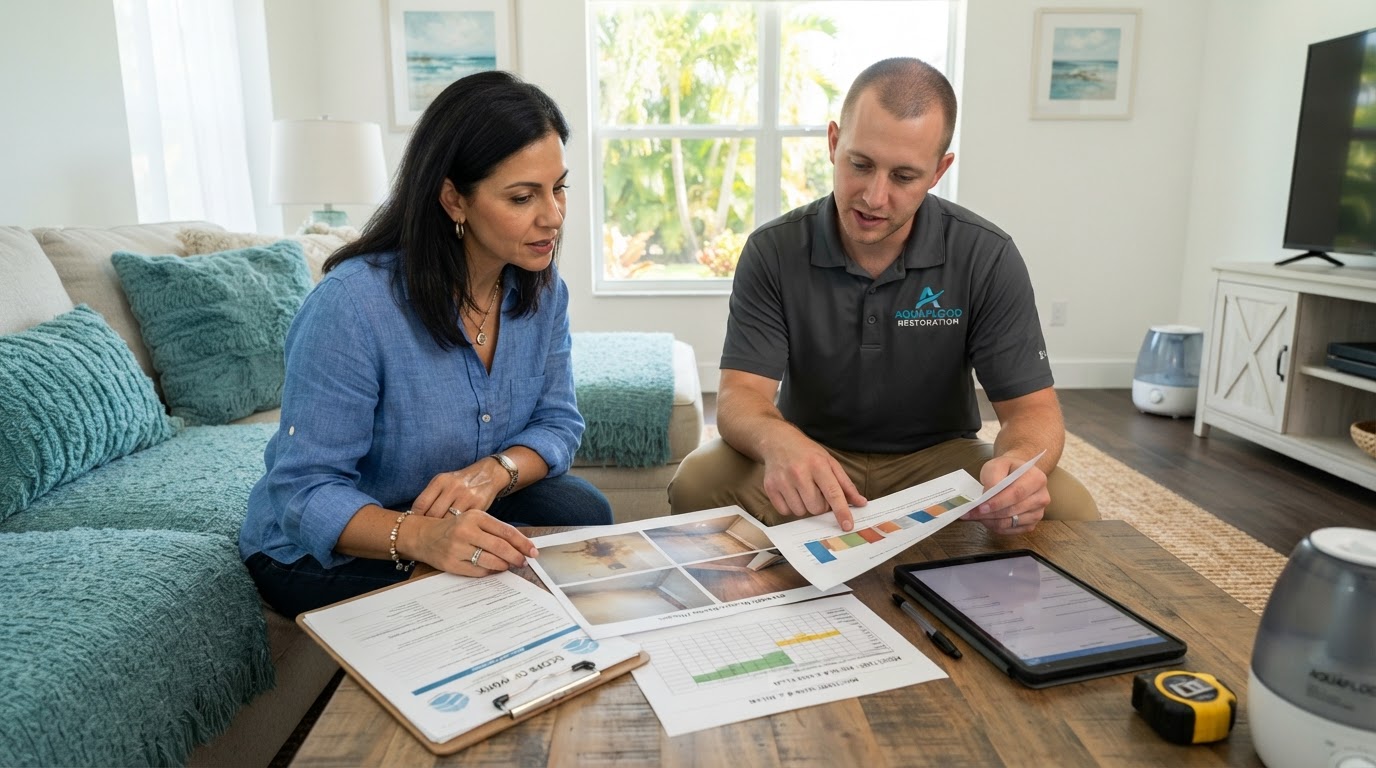
Organized documentation helps a homeowner communicate the known circumstances of a loss and the restoration work performed. Useful records include:
Typical Water Damage Claim Documentation Steps
After a water loss, personal safety comes first — standing water near electrical equipment, saturated flooring, and compromised ceilings can create hazards that should be addressed before documentation begins. Once safe, reasonable steps to prevent additional damage are appropriate, because most policies expect a policyholder to mitigate further loss. That may mean shutting off the water source, moving belongings away from wet areas, or arranging emergency extraction. Reporting the loss directly to the insurer, reviewing reporting obligations and policy requirements, and photographing the affected property when safe are the foundational documentation steps.
Factual damage records should be preserved throughout the process: moisture readings, drying logs, photographs of affected materials before and after removal, and descriptions of what was done and why. Legitimate mitigation invoices and repair estimates document the cost of the work performed, and maintaining insurance correspondence — claim numbers, adjuster notes, and the insurer's requests — keeps the communication organized. A restoration contractor can provide photographs, moisture records, and invoices that describe the factual work performed within its authorized scope.
It is important to distinguish restoration documentation from public adjusting. A restoration professional documents the damage and the work performed; a licensed public adjuster or attorney interprets policy language, negotiates coverage, and represents the policyholder in a dispute. These are different professional roles. When a coverage question or disputed claim arises, a licensed professional — a public adjuster or attorney — should be consulted for interpretation specific to the policy and the facts of the loss. No particular document guarantees payment, and the actual coverage decision depends on the policy terms and the facts of the loss.
1. Prioritize Safety
Address electrical, structural, and slip hazards before documenting the loss.
2. Prevent Further Damage
Take reasonable steps to stop the water source and mitigate additional loss.
3. Report the Loss
Report the water damage directly to the insurer and obtain a claim number.
4. Review Policy Duties
Review reporting obligations and policy requirements that apply to the loss.
5. Photograph Damage
Photograph affected property and materials when it is safe to do so.
6. Preserve Records
Preserve factual damage records, moisture readings, and drying logs.
7. Keep Mitigation Invoices
Keep legitimate invoices for emergency mitigation and extraction work.
8. Record Repairs
Record repairs, material replacement, and the scope of restoration work.
9. Maintain Correspondence
Maintain organized correspondence with the insurer throughout the claim.
10. Seek Licensed Help
Contact a licensed public adjuster or attorney for disputed coverage questions.
Water Damage Insurance Documentation Near Port Charlotte
Port Charlotte and Charlotte County homeowners face a range of water damage causes that may be treated differently under insurance policies. A burst pipe, a slab leak, a water heater failure, or an AC condensate overflow may involve different policy provisions than hurricane-related roof damage or floodwater intrusion. Condo plumbing leaks may involve both an individual unit owner's policy and the association's master policy. Because different causes of damage can be subject to different coverage provisions, factual documentation of the source and extent of the loss supports a clearer conversation with the insurer — but it does not determine coverage, which depends on the policy and the facts.
It is important not to conflate flood damage with homeowners water damage coverage. Rising surface water, storm surge, and overflow from a body of water are commonly addressed under separate flood insurance, while a sudden internal plumbing failure may be addressed under a homeowners policy — but the exact treatment depends on the policy language, the cause of loss, endorsements, and exclusions. The Flood vs. Water Damage Insurance Coverage page addresses that distinction in more detail. Presenting the two as interchangeable risks misunderstanding what a given policy covers.
Restoration documentation assistance means providing factual records of the damage and the work performed — photographs, moisture maps, drying logs, and invoices — within the authorized scope of the restoration work. It does not mean negotiating a claim, interpreting coverage, or guaranteeing a payment outcome. For Port Charlotte homeowners navigating a water damage claim after the Florida AOB changes, organized documentation is the practical contribution a restoration provider can make, while licensed professionals handle coverage interpretation and disputes.
Related Water Restoration Services
These related services often appear alongside water damage claims after aob changes in Port Charlotte properties.
Florida AOB & Water Damage Claim FAQs
Clear answers to the questions property owners most often ask about water damage claims after aob changes in Port Charlotte. Review them, then share your property details so the appropriate next steps can be discussed.
Request Water Damage Documentation Help
Tell us about the property damage and the location. Submit your inquiry so the appropriate next steps can be discussed.