
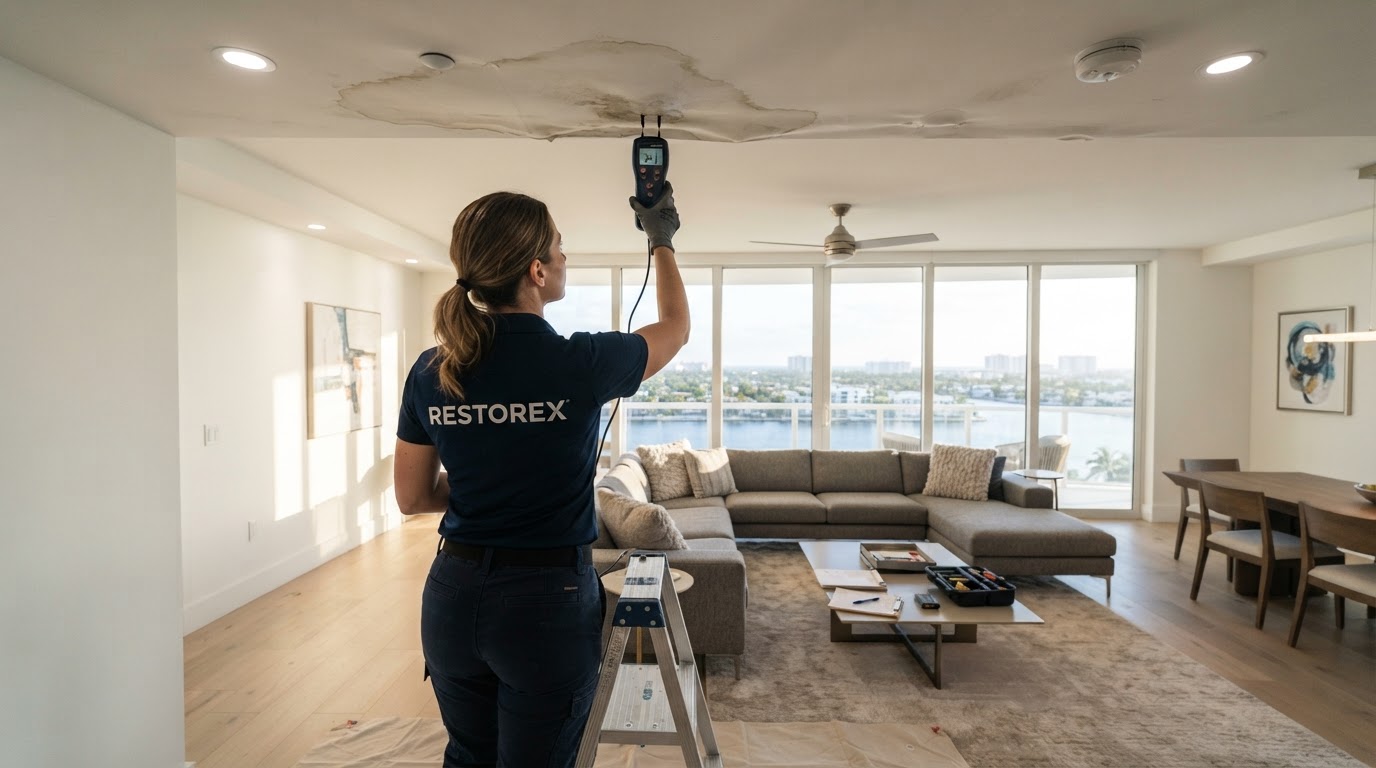
Upstairs Condo Water Damage Restoration Port Charlotte
Upstairs condo water damage restoration addresses ceiling, drywall, insulation, and flooring damage caused by a leak from the unit above. In Port Charlotte, FL, explore moisture assessment, multiunit coordination, structural drying, responsibility considerations, and restoration documentation throughout Charlotte County.
Request Restoration Help
Tell us about the property damage and the location. Submit your inquiry so the appropriate next steps can be discussed.
Condo Water Damage From an Upstairs Unit in Port Charlotte
Water damage originating in an upstairs condominium unit can affect the unit below in ways that are not immediately apparent. A plumbing leak, an overflowing bathtub, a washing machine supply line failure, a leaking dishwasher, a toilet supply line failure, or a water heater leak in the unit above can send water through the floor and ceiling assemblies — across the subfloor, through the ceiling drywall, into the wall cavities, and across the flooring below. In Port Charlotte and Charlotte County, where multiunit condominium buildings are common, these situations can involve several parties at once: the affected unit owner, the upstairs unit owner, the condominium association, the property manager, the insurance companies, and the restoration professionals.
Water travels through condominium building materials along the path of least resistance. It can run along the underside of the upstairs subfloor, wick into the ceiling drywall below, follow electrical and plumbing penetrations into wall cavities, and saturate the flooring and baseboards in the lower unit. By the time the damage is visible — a ceiling stain, a sagging drywall seam, a damp wall — the moisture may have already spread well beyond the visible area. A thorough assessment maps the full extent of the migration, including the concealed moisture behind finishes and inside the shared assemblies.
This page addresses the property damage and restoration problem first — the ceiling, drywall, insulation, flooring, and cabinetry that need drying and repair — while also addressing the responsibility and insurance questions that accompany a multiunit loss. Who pays for water damage from the unit above depends on the cause of the leak, who is responsible for the failed component, the governing documents, the master and individual insurance policies, and the applicable Florida law. These are related but not identical questions, and the answers are not the same in every situation.
Who Pays for Water Damage From an Upstairs Condo?
The responsibility question — who pays — is separate from the restoration question — what needs to be done. Responsibility may depend on:
Upstairs Condo Leak Damage Assessment & Restoration
The restoration sequence begins with safe access and a damage assessment. The ceiling stains, sagging drywall, wet insulation, moisture inside wall cavities, damaged flooring, and cabinet moisture are mapped to establish the full extent of the water migration. The water source is identified and coordinated to be stopped — whether that requires the upstairs owner, the association, or a plumber — because drying cannot succeed while water continues to enter. Where standing water is present, water removal precedes the drying work.
Structural drying addresses the moisture in the ceiling drywall, the wall cavities, the flooring, and any other affected materials, with monitoring across the affected area over multiple visits. The affected drywall and insulation are evaluated to determine what can be dried and salvaged versus what requires removal — ceiling drywall that has lost integrity, insulation that cannot be effectively dried, and materials exposed to contamination may require removal. Moisture monitoring continues until the affected materials reach an appropriate dry standard, and the restoration is documented for the owner, the association, and the insurer.
Material repair and reconstruction planning follow the drying. The ceiling, drywall, insulation, flooring, and finishes that require replacement are identified, and the reconstruction is coordinated with qualified trades. Because multiple units may be affected, the assessment and the documentation are coordinated across the involved parties. A specific drying duration is not promised, because the timeline depends on the materials, the water source, the extent of saturation, the building conditions, and the access available.
1. Safe Access & Assessment
Assess ceiling stains, sagging drywall, wet insulation, wall cavities, flooring, and cabinet moisture.
2. Source Coordination
Coordinate stopping the water source — upstairs owner, association, or plumber — before drying begins.
3. Moisture Inspection
Map the full extent of water migration through floor and ceiling assemblies, including concealed areas.
4. Water Removal
Remove standing water where present, before structural drying.
5. Structural Drying
Dry ceiling drywall, wall cavities, flooring, and affected materials with monitoring over multiple visits.
6. Material Evaluation
Evaluate affected drywall and insulation for drying feasibility versus removal.
7. Moisture Monitoring
Continue monitoring until affected materials reach an appropriate dry standard.
8. Documentation
Document the restoration for the owner, the association, and the insurer.
9. Repair & Reconstruction
Plan material repair and reconstruction, coordinating qualified trades for replacement work.
Condo Water Damage Restoration Near Port Charlotte
In Port Charlotte and Charlotte County, multiunit residential buildings involve shared plumbing, upper-floor bathrooms, and ceiling assemblies that can transmit water between units. Association approval, property manager access, and building rules shape how the restoration proceeds — access to the upstairs unit may be needed to stop the source, and the association may need to be involved where shared components are affected. Unit-owner documentation, including photographs of the damage, moisture readings, and restoration invoices, helps each party maintain an organized loss file.
Practical recordkeeping supports the process. Recording when the damage was discovered, photographing the visible damage when safe, notifying the relevant property manager or association, preserving correspondence, recording known information about the water source, and keeping restoration invoices and factual damage reports all help the parties coordinate. This is factual recordkeeping — it does not determine liability or insurance coverage, which depend on the governing documents, the policies, and the applicable law.
This page does not provide definitive liability or insurance coverage advice. The responsibility question — who pays — depends on the cause of the leak, the responsibility for the failed component, the governing documents, the master and individual policies, and the applicable Florida law. For case-specific interpretation, readers should consult their association, their insurer, or a qualified Florida legal professional. The restoration provider documents the work performed and the affected components; the parties and their insurers address the responsibility and coverage questions.
Related Water Restoration Services
These related services often appear alongside upstairs condo water damage restoration in Port Charlotte properties.
Upstairs Condo Water Damage FAQs
Clear answers to the questions property owners most often ask about upstairs condo water damage restoration in Port Charlotte. Review them, then share your property details so the appropriate next steps can be discussed.
Request Condo Water Damage Help
Tell us about the property damage and the location. Submit your inquiry so the appropriate next steps can be discussed.