Smoke & Soot Damage Cleanup Port Charlotte
Smoke and soot damage cleanup identifies the residue a fire left behind and removes it without making the problem worse. Different fires leave different soot — dry and powdery, or oily and greasy — and the wrong cleaning method can smear residue permanently into a finish. In Port Charlotte, FL, explore residue identification, surface-specific cleaning, HVAC evaluation, and source odor treatment throughout Charlotte County.
Request Restoration Help
Tell us about the property damage and the location. Submit your inquiry so the appropriate next steps can be discussed.
Professional Smoke & Soot Cleanup in Port Charlotte
Smoke and soot damage cleanup is the surface-specific work of identifying the residue a fire left behind and removing it without making the problem worse. The defining challenge of soot cleanup is that not all soot is the same: a fast, hot fire leaves a dry, powdery residue that can often be removed with dry cleaning methods, while a slow, smoldering fire or a protein and grease fire leaves an oily, sticky residue that smears and embeds when wiped like ordinary dust. Identifying the residue type is the first step, because the wrong cleaning approach can permanently stain a finish.
Smoke also deposits far from the fire's origin. Heat and air currents carry particulate through open doorways, into closets, behind cabinets, and across an entire HVAC distribution system. A room that looks untouched can still have a fine soot film on surfaces, residue inside supply registers, and odor absorbed into porous materials like drywall, upholstery, and clothing. A thorough smoke assessment evaluates the whole structure, not just the rooms where the fire burned.
Odor is the other half of smoke damage. Smoke compounds penetrate porous materials and continue to release odor long after surfaces look clean. Removing visible soot without addressing the absorbed odor is incomplete work. A credible smoke cleanup plan coordinates residue removal with source odor treatment — cleaning contaminated surfaces, evaluating porous materials for removal versus restoration, and applying deodorization methods matched to what was burned.
Signs of Hidden Smoke & Soot Contamination
Smoke residue and odor often extend well beyond the visible fire area. These indicators suggest soot contamination may be present in places that are not immediately obvious:
How Professional Smoke Damage Cleanup Works
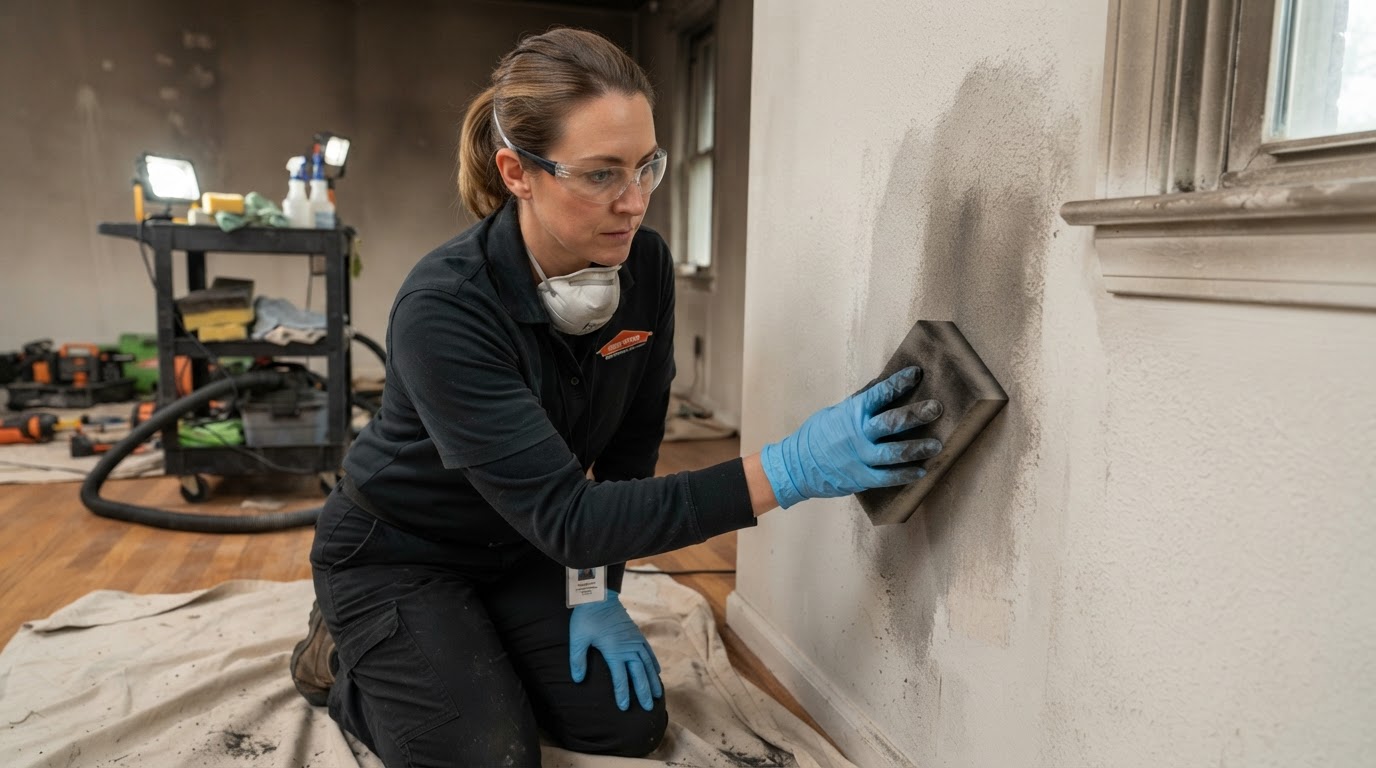
Smoke cleanup begins with a damage assessment that identifies the type of residue present and the extent of its spread. Dry soot from a fast, hot fire responds to dry removal methods such as chemical sponges and HEPA vacuuming. Oily or protein residue from a kitchen or smoldering fire requires different, wet-based cleaning methods. Using the wrong approach — wiping dry soot with a wet cloth, for instance — can smear the residue and permanently stain the surface, so identification precedes any cleaning.
Containment is applied where soot could be redistributed into unaffected areas during the cleaning process. Surfaces are cleaned using methods matched to the material and residue type, and porous materials that have absorbed heavy soot or odor are evaluated for whether they can be restored or must be removed. HEPA filtration may be used to capture airborne particulate during the work. Because smoke often enters the HVAC system, ductwork and air distribution components are evaluated as part of the scope.
Odor treatment runs alongside the residue removal. Removing visible soot without addressing the odor absorbed into porous materials leaves the job incomplete. Source-specific deodorization methods — matched to what was burned and how deeply the compounds penetrated — are applied where appropriate. The final step is a cleaning verification and restoration plan for any materials that require further work.
1. Damage Assessment
Evaluate the full structure for soot spread and identify the residue type — dry, oily, or protein — which determines the correct cleaning method.
2. Residue Identification
Determine what was burned and how the soot will respond to cleaning, because mismatched methods can permanently smear and stain surfaces.
3. Containment
Isolate the work area where needed so cleaning does not redistribute soot into unaffected rooms and air distribution paths.
4. Dry Residue Removal
Use chemical sponges and HEPA vacuuming for dry soot before any wet cleaning, to avoid embedding the residue into the finish.
5. Surface-Specific Cleaning
Clean salvageable surfaces with methods matched to the material and residue type, evaluating porous materials for removal versus restoration.
6. Odor Treatment
Address porous materials that absorbed smoke compounds with source-specific deodorization, rather than masking with fragrance.
7. HVAC Evaluation
Inspect ductwork and air distribution components for soot deposits, since smoke commonly travels through the HVAC system.
8. Final Cleaning & Planning
Verify cleaning results and document any materials requiring further restoration or reconstruction work.
Smoke Damage Restoration Near Port Charlotte Properties
In Port Charlotte and Charlotte County, smoke damage often originates in residential kitchens but spreads throughout the home. Cooking and grease fires produce an oily, sticky soot that coats cabinets, ceilings, and the range hood area, and the smoke travels through open floor plans into living areas, bedrooms, and the HVAC system. Even a fire contained to one room can leave residue and odor across an entire house, which is why a full-structure assessment is part of any smoke cleanup.
Smoke also affects commercial interiors differently than homes — larger HVAC systems, open floor plans, and greater air movement can distribute soot across a wider area, and sensitive contents such as electronics, inventory, and office equipment may be affected. Attic spaces and storage areas can trap smoke that goes unnoticed until an inspection. The cleaning plan must account for the building's specific layout and air distribution.
Seasonal homes present a particular concern: if a fire occurs and the smoke sits undisturbed for days or weeks before discovery, the residue bonds more tightly to surfaces and the odor penetrates more deeply into porous materials. Prompt assessment after discovery is important because the longer soot and odor remain, the more difficult and costly the restoration becomes.
Related Water Restoration Services
These related services often appear alongside smoke & soot damage cleanup in Port Charlotte properties.
Smoke & Soot Damage Cleanup FAQs
Clear answers to the questions property owners most often ask about smoke & soot damage cleanup in Port Charlotte. Review them, then share your property details so the appropriate next steps can be discussed.
Request Smoke & Soot Cleanup Help
Tell us about the property damage and the location. Submit your inquiry so the appropriate next steps can be discussed.