Hardwood Floor Water Damage Drying in Port Charlotte, FL
Hardwood flooring is one of the materials most sensitive to water, and when moisture reaches the planks the wood expands — producing cupping, crowning, and in severe cases buckling. In Port Charlotte, FL, explore how water-damaged hardwood is assessed, when it can be dried in place versus removed, and how the subfloor beneath is dried.
Request Restoration Help
Tell us about the property damage and the location. Submit your inquiry so the appropriate next steps can be discussed.
How Water Damages Hardwood Floors
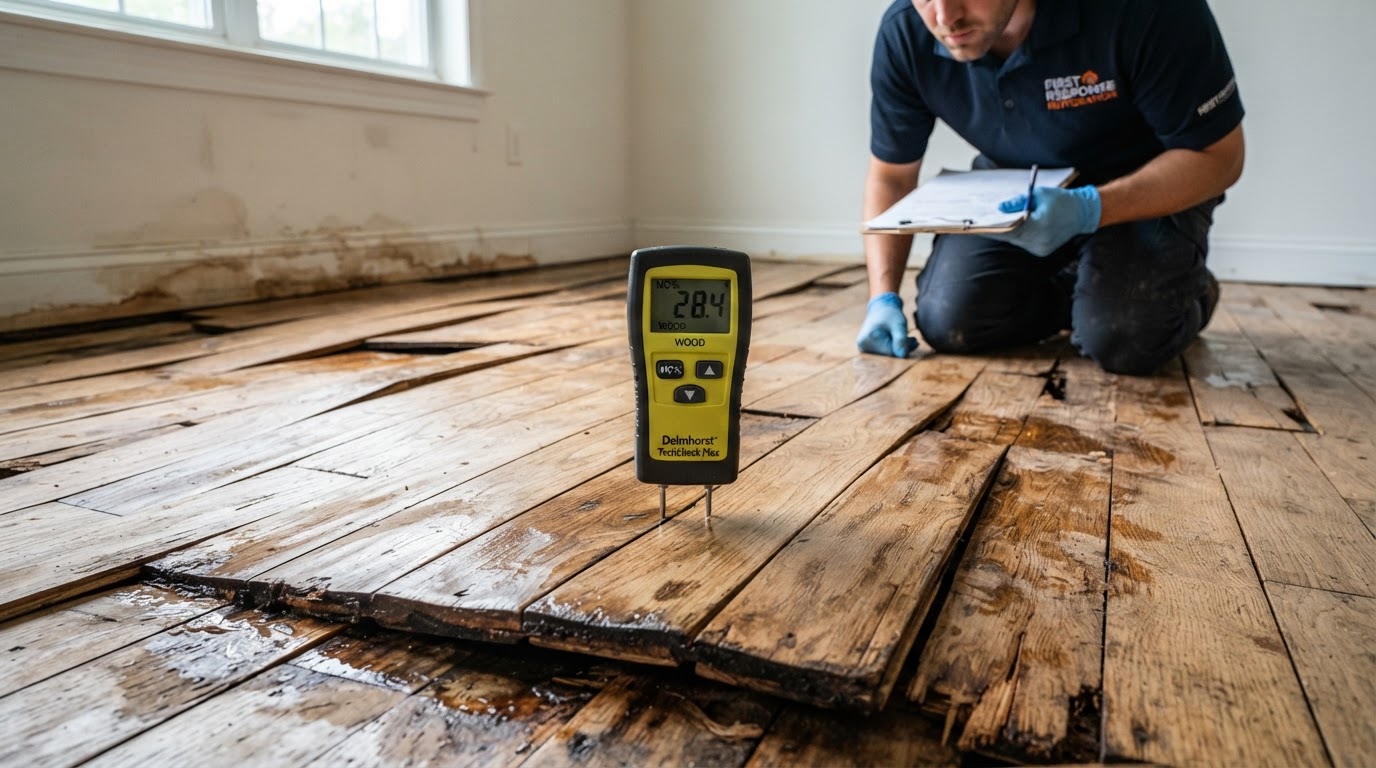
Hardwood flooring is one of the materials most sensitive to water, because wood is hygroscopic — it absorbs moisture and changes dimension as it does. When water reaches a hardwood floor, the planks absorb it through the finish, the edges, and the underside, and the wood expands. That expansion has nowhere to go but upward and sideways, which is why the first signs of water damage in hardwood are cupping (edges rising above the center), crowning (the center rising above the edges), and in severe cases buckling (planks lifting entirely off the subfloor).
The damage depends on the type of hardwood, the finish, the adhesive, and the subfloor beneath. Solid hardwood expands more than engineered wood, which has a dimensional stabilizing core. A floor that is nailed down responds differently than one that is glued down, because an adhesive failure can let water travel beneath the entire floor. The finish can trap moisture beneath it, slowing drying and increasing the risk of finish damage. Each factor shapes whether the floor can be dried in place, refinished, or must be removed and replaced.
Not every water-damaged hardwood floor can be saved. A floor that has cupped mildly from a brief, clean-water exposure can often be dried in place and refinished once it returns to a stable moisture content. A floor that has buckled, that was exposed to contaminated water, or where the subfloor beneath has absorbed water and cannot be dried with the flooring in place may require removal. The assessment reads the moisture in the flooring and the subfloor, and the restoration decision follows the measured conditions rather than a promise that every floor can be restored.
Signs of Water Damage in Hardwood Flooring
Hardwood shows water damage through dimensional changes in the planks. These are the signs that warrant a moisture assessment of the flooring and subfloor:
Hardwood Floor Moisture Assessment & Drying
Restoration begins with identifying and stopping the water source, then mapping the moisture in the hardwood flooring and the subfloor beneath. Moisture meters read the water content of the planks at the surface and beneath the finish, and a pin-type meter can probe the subfloor below. The assessment distinguishes between cupping that may resolve with drying, crowning that often indicates the floor has already gone through a wet-dry cycle, and buckling that generally requires plank replacement. The moisture map drives the drying plan.
Where the floor can be dried in place, controlled drying is set up with air movement and dehumidification monitored over multiple visits, and the flooring is assessed at each visit for changes in moisture content and dimensional stability. Drying hardwood is slower than drying carpet or drywall, because the wood releases moisture gradually, and the floor is monitored until it returns to an appropriate moisture content for the ambient conditions. The finish is evaluated, because a finish that traps moisture can slow drying and may need to be addressed.
Where the floor has buckled, where the subfloor cannot be dried with the flooring in place, or where contaminated water has been absorbed, planks are removed to access and dry the subfloor beneath. Severely distorted or contaminated planks are replaced. Once the flooring and subfloor are confirmed dry, the floor is evaluated for refinishing — sanding and resealing to address cupping, crowning, or finish damage — or replacement, depending on the extent of the dimensional change and the material condition. The scope is documented to support the repair and refinishing work that follows.
1. Source Identification
Identify and stop the water source affecting the hardwood floor.
2. Moisture Assessment
Map the moisture in the flooring and subfloor with meters to determine the extent of saturation.
3. Damage Classification
Distinguish cupping, crowning, and buckling to determine drying versus removal.
4. Controlled Drying
Set up and monitor air movement and dehumidification on the flooring and subfloor to verified targets.
5. Subfloor Evaluation
Assess the subfloor for moisture and structural integrity, removing flooring where needed to dry it.
6. Plank Removal Where Necessary
Remove buckled, severely distorted, or contaminated planks to access and dry the subfloor.
7. Refinishing Evaluation
Evaluate the floor for sanding, refinishing, or replacement once it returns to a stable moisture content.
8. Documentation & Repair Planning
Document the scope and plan the refinishing or replacement work to return the floor to pre-loss condition.
Hardwood Floor Restoration Near Port Charlotte
In Port Charlotte and Charlotte County, hardwood floors face two compounding factors: high ambient humidity and seasonal occupancy. A hardwood floor in a humid environment already carries a higher equilibrium moisture content than one in an arid climate, which means it has less capacity to absorb additional water before dimensional change begins. When a water loss occurs, the floor cups or crowns more readily here than it would in a dry climate, and it dries more slowly because the ambient air is already moisture-laden.
Seasonal homes compound the timeline. A water loss in an unoccupied property can saturate a hardwood floor for days or weeks before discovery, by which point the planks have often buckled and the subfloor has absorbed substantial moisture. In those cases, the floor is frequently removed rather than dried in place, and the assessment accounts for the extended exposure and the possibility of suspected mold conditions in the subfloor. The source is corrected, the subfloor is dried, and the replacement or refinishing is planned once the assembly is confirmed stable.
Related Water Restoration Services
These related services often appear alongside hardwood floor water damage drying in Port Charlotte properties.
Hardwood Floor Water Damage Drying FAQs
Clear answers to the questions property owners most often ask about hardwood floor water damage drying in Port Charlotte. Review them, then share your property details so the appropriate next steps can be discussed.
Request Hardwood Floor Water Damage Help
Tell us about the property damage and the location. Submit your inquiry so the appropriate next steps can be discussed.