
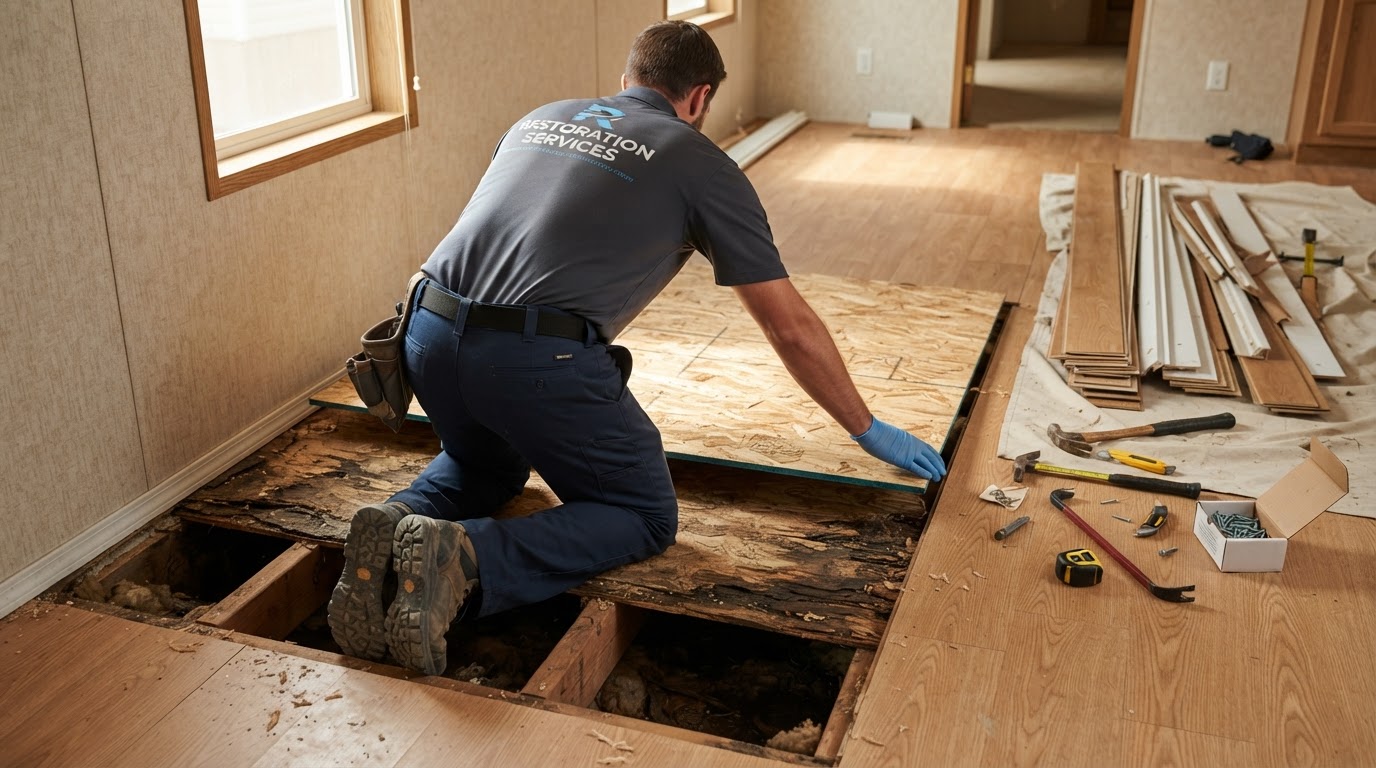
Mobile Home Subfloor Replacement Port Charlotte
Mobile home subfloor replacement restores the structural layer beneath the finished flooring when moisture-sensitive materials have swollen, softened, or lost integrity after a leak. In Port Charlotte, FL, explore soft floor assessment, moisture-sensitive particleboard damage, the repair-versus-replacement decision, and qualified subfloor restoration throughout Charlotte County.
Request Restoration Help
Tell us about the property damage and the location. Submit your inquiry so the appropriate next steps can be discussed.
Water-Damaged Mobile Home Subfloors in Port Charlotte
Mobile home subfloor replacement addresses the structural layer beneath the finished flooring when it has been weakened by moisture. The subfloor is the panel material — particleboard, plywood, or another panel product — that spans the floor framing and supports the finished floor above. When a plumbing leak, appliance overflow, toilet supply failure, water heater leak, or roof intrusion allows water to reach the subfloor, moisture-sensitive materials can swell, soften, and lose structural integrity, leaving the floor soft, spongy, or sagging underfoot.
The key technical distinction is that not all subfloor materials behave the same way. Particleboard, which is used in some manufactured homes, can lose integrity after substantial moisture exposure — the fibers swell, the panel softens, and the structural capacity is compromised. Other panel products, such as plywood or oriented strand board, can behave differently and may tolerate limited moisture exposure if dried promptly. The appropriate response depends on the material, the degree of swelling, the structural condition, the contamination, and the drying feasibility — not on a blanket rule that every wet subfloor must be replaced.
This page is more specialized than the broader manufactured home water damage page. It focuses on the flooring assembly, the moisture-sensitive materials, the subfloor assessment, and the replacement planning — the specific question of when the subfloor needs to come out and what the replacement involves. It connects to the broader water damage and structural drying pages for the surrounding mitigation work.
Soft Floors, Subfloor Damage & Replacement Indicators
Soft or compromised subfloors produce observable signs. These are the indicators that a subfloor may need professional evaluation and possible replacement:
Mobile Home Subfloor Assessment & Replacement Process
The process begins with inspecting the visible damage and identifying and stopping the water source — the subfloor cannot be repaired before the moisture source is resolved. Floor stability is evaluated, and the subfloor material is identified. Moisture and contamination are assessed, because a subfloor exposed to Category 3 water or sewage may require removal regardless of its structural condition. Structural supports beneath the subfloor are evaluated, because the repair must address the framing as well as the panel.
The repair versus replacement decision depends on the material and the condition. A subfloor that has swollen, softened, or lost structural integrity generally requires replacement; a subfloor that has had limited moisture exposure and can be dried to an appropriate standard may be retained. Where replacement is needed, the damaged material is removed safely, the underlying moisture is addressed, and appropriate replacement materials are installed. The finished flooring is then restored.
Qualified contractors must determine the appropriate load-bearing repairs, fastening, spans, materials, and applicable code requirements. This page does not provide structural cutting instructions or specific construction guidance — subfloor replacement in a manufactured home involves structural considerations that require qualified assessment. The source of moisture must be repaired before the replacement flooring is installed, or the new subfloor will face the same risk.
1. Visible Damage Inspection
Inspect the visible damage — soft spots, swelling, sagging — and identify the affected areas.
2. Source Correction
Identify and stop the water source before any subfloor work begins.
3. Floor Stability Evaluation
Evaluate the stability of the floor and the extent of the structural compromise.
4. Subfloor Material Identification
Determine the subfloor material — particleboard, plywood, or another panel product.
5. Moisture & Contamination Assessment
Assess the moisture levels and any contamination that may require removal regardless of condition.
6. Structural Support Evaluation
Evaluate the structural supports beneath the subfloor, because the repair addresses framing as well as panel.
7. Repair vs. Replacement Decision
Determine whether the subfloor can be dried and retained or requires removal and replacement.
8. Damaged Material Removal
Remove damaged material safely where replacement is needed, without unsafe structural cutting.
9. Underlying Moisture Address
Address the underlying moisture and dry the area before any new material is installed.
10. Replacement Material Installation
Install appropriate replacement materials, with fastening and code requirements determined by qualified contractors.
11. Finished Flooring Restoration
Restore the finished flooring over the repaired subfloor.
12. Safe Condition Verification
Verify safe conditions and confirm the source repair has resolved the moisture risk.
Mobile Home Floor Restoration Near Port Charlotte
In Port Charlotte and Charlotte County, mobile home floor restoration often involves moisture beneath bathrooms, where toilet supply failures and tub overflows can saturate the subfloor; kitchen and utility plumbing, where appliance and water heater leaks can affect the surrounding flooring; and water intrusion after storms, where roof leaks or wind-driven rain can reach the subfloor through the ceiling and walls. Seasonal homes add the complication of leaks discovered late, after the subfloor has had time to deteriorate.
Under-home access restrictions shape the assessment. Some manufactured homes have limited access to the space beneath the floor, which affects how thoroughly the under-home insulation, vapor barriers, and structural supports can be inspected. Insulation and vapor-control considerations matter, because the replacement must restore not only the subfloor but the protective layers beneath it. Coordinating plumbing and restoration work is often necessary, because the source repair and the subfloor replacement are interdependent.
The importance of repairing the source of moisture before replacing flooring cannot be overstated. Installing a new subfloor over an unresolved leak guarantees the new material will face the same damage. The cost and scope of mobile home subfloor replacement depend on the damaged area, the flooring system, the access, the materials, the labor, and the structural conditions — this page does not fabricate precise pricing, because those factors vary by project. A qualified assessment establishes the actual scope for the specific home.
Related Water Restoration Services
These related services often appear alongside mobile home subfloor replacement in Port Charlotte properties.
Mobile Home Subfloor Replacement FAQs
Clear answers to the questions property owners most often ask about mobile home subfloor replacement in Port Charlotte. Review them, then share your property details so the appropriate next steps can be discussed.
Request Mobile Home Subfloor Repair Help
Tell us about the property damage and the location. Submit your inquiry so the appropriate next steps can be discussed.