
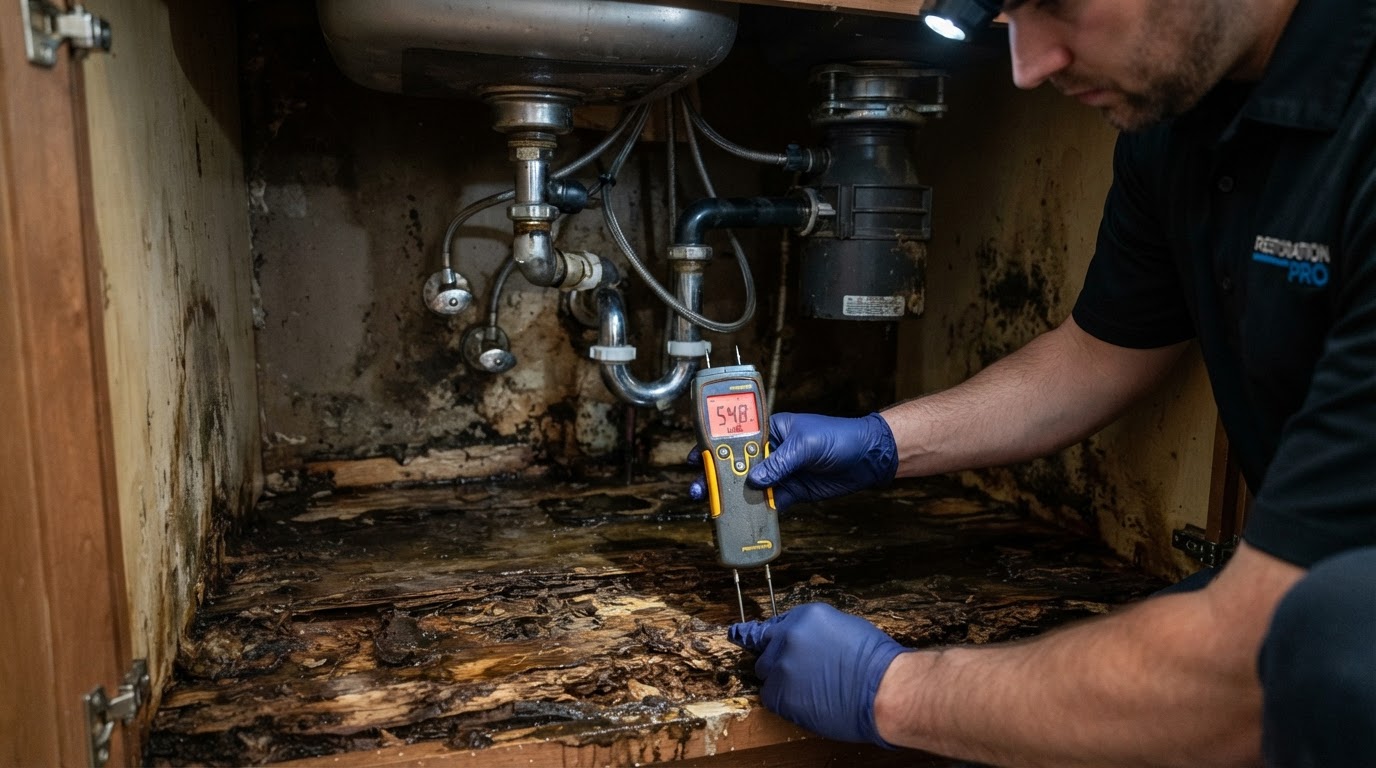
Kitchen Cabinet Water Damage Restoration in Port Charlotte, FL
Kitchen cabinets sit over the subfloor and against the wall, and the plumbing that serves the sink, dishwasher, and refrigerator runs directly beneath them. In Port Charlotte, FL, explore how leaks beneath and behind cabinetry are assessed, when cabinets can be dried versus removed, and how the subfloor beneath is dried.
Request Restoration Help
Tell us about the property damage and the location. Submit your inquiry so the appropriate next steps can be discussed.
Water Damage Beneath & Behind Kitchen Cabinets
Kitchen cabinets sit against the wall and over the subfloor, and the plumbing that serves the sink, dishwasher, refrigerator, and ice maker runs directly beneath and behind them. When a supply line, drain, or appliance connection fails, the water releases at floor level and runs beneath the cabinetry, into the toe-kick, and along the baseboard before it ever spreads visibly across the kitchen floor. Because the cabinet bases conceal the subfloor and the wall behind the plumbing, a kitchen cabinet leak is often hidden until the cabinet swells, the flooring warps, or a musty odor appears.
The damage depends on the cabinet construction. Solid wood and plywood cabinets tolerate brief, clean-water exposure better than particleboard or MDF, which absorb water readily, swell, and lose structural integrity. Laminate finishes can delaminate from the substrate beneath. The toe-kick at the base of the cabinet is frequently where the water pools, because it is the lowest point and the least visible — and the subfloor beneath it is often the most saturated area in the kitchen, even when the visible floor looks dry.
The restoration is not represented as able to save every cabinet. A cabinet that has absorbed clean water briefly and retains its integrity can sometimes be dried in place; a cabinet that has swollen, delaminated, or absorbed contaminated water may require removal and replacement. The assessment reads the moisture in the cabinet, the subfloor beneath it, and the wall behind it, because the water rarely stays confined to the visible surfaces.
Signs of Water-Damaged Kitchen Cabinets
Because kitchen leaks often start beneath or behind the cabinetry, the visible signs appear in the cabinet materials and surrounding finishes first. These are the indicators that warrant a subfloor and cabinet moisture assessment:
Cabinet Moisture Assessment, Drying & Repair
Restoration begins with identifying the leak source — the supply line, drain, dishwasher connection, or refrigerator line that has failed — and coordinating a qualified technician for the plumbing or appliance repair, which is a separate scope from the water damage mitigation. A moisture inspection then maps how far the water has traveled: into the cabinet base, the toe-kick, the subfloor beneath, the drywall behind, and the flooring around the cabinetry. Standing water is removed where present, and the affected materials are evaluated.
Cabinets that have absorbed water are inspected for subfloor access — the toe-kick may be opened to reach and dry the subfloor beneath the cabinetry, because the subfloor is often the most saturated area and cannot be dried with the cabinet sealed above it. Cabinet materials that have swollen, delaminated, or absorbed contaminated water are evaluated for removal and replacement rather than attempted salvage. Air movers and dehumidification are set up and monitored to verified moisture targets on the subfloor, the wall behind, and the surrounding flooring.
The scope is documented to support the cabinet, flooring, drywall, and finish repair that follows. Not every cabinet can be saved, and a credible assessment says so plainly rather than promising to salvage materials that have lost integrity. Where the cabinet has been removed to access the subfloor, the replacement is planned once the assembly is confirmed dry, coordinated with the plumbing or appliance repair that corrected the source.
1. Source Identification
Identify the supply line, drain, or appliance connection that has failed and coordinate the repair.
2. Moisture Inspection
Map the moisture in the cabinet, toe-kick, subfloor, wall behind, and surrounding flooring.
3. Water Removal
Remove standing water and accessible moisture from the cabinet and floor area.
4. Cabinet Evaluation
Assess cabinet materials for salvageability versus removal based on water category and condition.
5. Subfloor Access & Drying
Open the toe-kick where needed to reach and dry the subfloor beneath the cabinetry.
6. Structural Drying
Set up and monitor air movers and dehumidification on the subfloor, wall, and flooring to verified targets.
7. Removal Where Necessary
Remove cabinets or materials that have lost integrity or absorbed contaminated water.
8. Documentation & Repair Planning
Document the scope and plan cabinet, flooring, drywall, and finish repair to return the kitchen to pre-loss condition.
Kitchen Cabinet Restoration Near Port Charlotte
In Port Charlotte and Charlotte County, kitchen cabinet water damage often involves slab construction, where the subfloor is concrete and the cabinetry sits directly above it. Water that runs beneath the cabinet pools against the slab and wicks into the toe-kick and the cabinet base, and in humid conditions the subfloor and cabinet materials dry slowly — which raises the risk of microbial growth in the concealed assembly if drying is delayed. The assessment reads the subfloor beneath the cabinet, not just the visible cabinet surfaces.
Seasonal homes add a layer of complexity. A slow leak beneath a kitchen sink in an unoccupied property can run for weeks before discovery, by which point the cabinet base has often swollen, the subfloor is saturated, and the drywall behind the cabinet has absorbed moisture. In those cases, the cabinet may require removal to access and dry the subfloor, and the assessment accounts for the extended exposure and the possibility of suspected mold conditions. The source is corrected and the assembly is dried before any replacement cabinetry is installed.
Related Water Restoration Services
These related services often appear alongside kitchen cabinet water damage restoration in Port Charlotte properties.
Kitchen Cabinet Water Damage Restoration FAQs
Clear answers to the questions property owners most often ask about kitchen cabinet water damage restoration in Port Charlotte. Review them, then share your property details so the appropriate next steps can be discussed.
Request Kitchen Cabinet Water Damage Help
Tell us about the property damage and the location. Submit your inquiry so the appropriate next steps can be discussed.